Library
50,000 volumes on open shelves in Somali, English and Arabic, in fiction and non-fiction sections, with a reading room of long tables under the central skylight.
The first public library and innovation center in the Somali Region of Ethiopia.
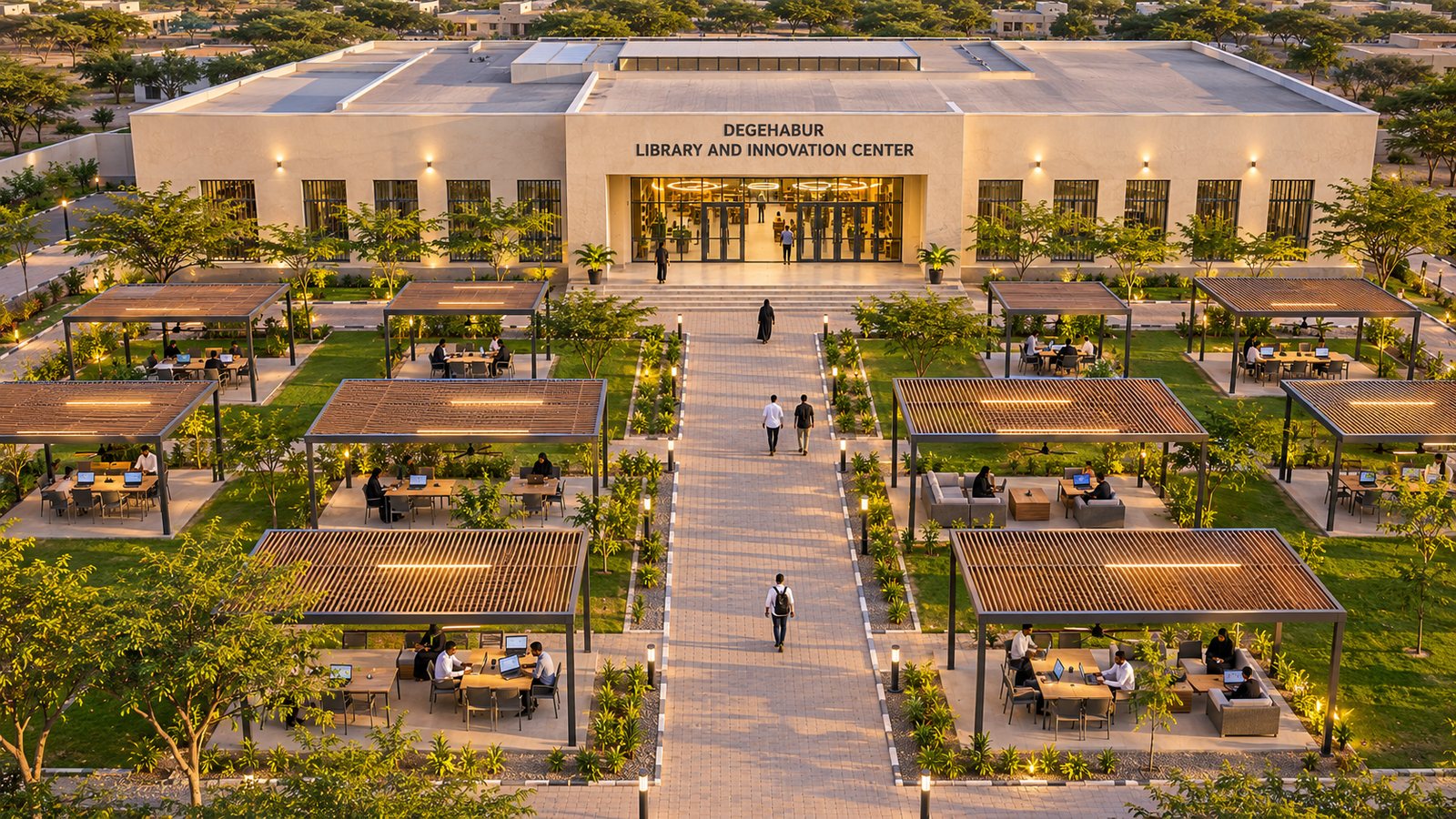
The first public library and innovation center in the Somali Region of Ethiopia: a single-storey, light-filled building where a town of readers, students, founders and makers can learn and build under one roof, set in gardens made for reading outdoors.
Degehabur has no public library, no public computer hall and no place where a young person with an idea can find tools, mentors or a quiet desk. SEED is building all of these in one institution. The building holds 50,000 books across fiction, non-fiction and a dedicated children’s library; a computer hall of 100 workstations with power and data at every seat; a reading room under a daylit roof; group study rooms; a startup space with desks and mentors for founders; a maker space with tools and electronics for engineers and tradespeople; and a research unit that studies the region’s education, farming and economy and publishes what it learns for the public and for government. Through international subscriptions and open-access programs, readers will also have access to the world’s scientific journals, textbooks and university course materials, so that current research and best practice reach Degehabur directly.
Outside, the whole site is a green lawn with shaded pergolas, benches and tables, lit in the evening, so that the gardens are as much a place to read and work as the building itself. Large windows along the front bring the garden in and let passers-by see the shelves and the people at them.
The library will be free and open to everyone: schoolchildren who need a quiet place to study, students preparing for national exams, adults learning to read, and anyone with a question and no internet at home. It is built to be run by local staff and handed to the community for generations.
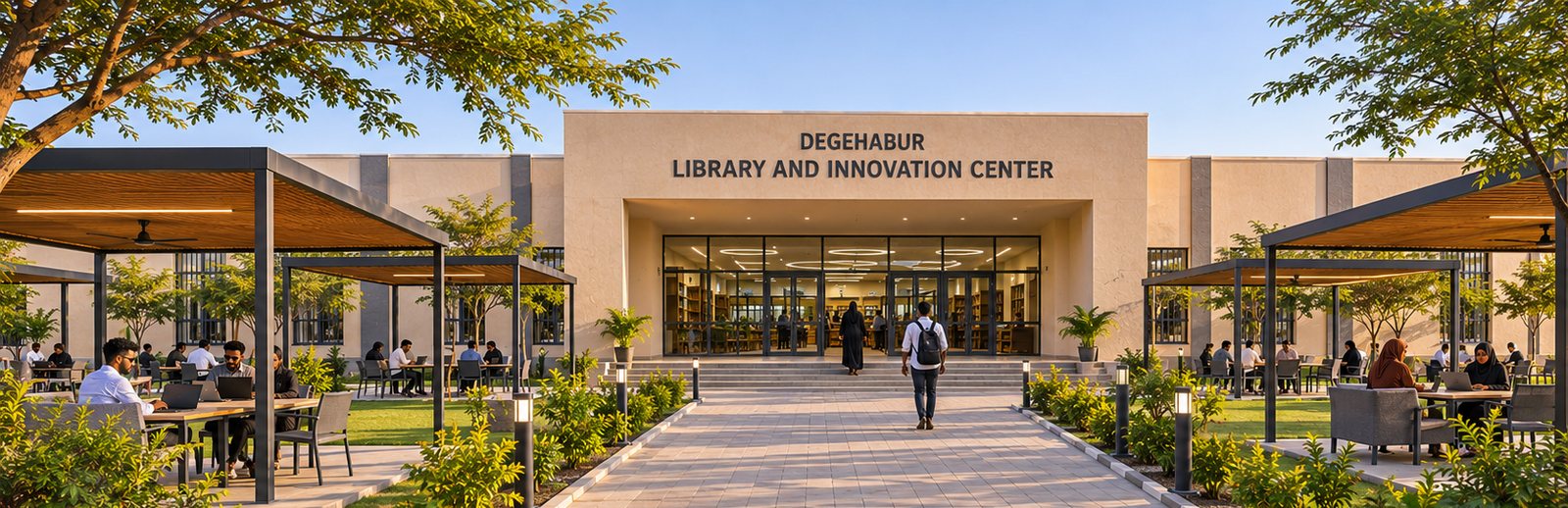
50,000 volumes on open shelves in Somali, English and Arabic, in fiction and non-fiction sections, with a reading room of long tables under the central skylight.
Low shelves, round tables and a story corner behind the largest windows, with its own entrance from the garden.
100 workstations for study, exam preparation, online courses and digital skills, with trained staff on hand.
Desks and mentors for founders; workbenches, tools and electronics for engineers and tradespeople to build, test and repair.
A base for studying the region’s education, agriculture and economy, with findings published openly for the public and government.
Subscriptions and open-access programs that put the world’s journals, textbooks and course materials in readers’ hands, free, on the premises.
Glazed group study rooms for exam preparation, tutoring and small classes, bookable by schools and students.
Lawns, shaded pergolas, benches and tables, lit at night, planted with shade trees, open to the whole town.
The library will hold more than books. Through institutional subscriptions and open-access programs, its readers and its computer hall will have access to the same journals, textbooks and course materials used in universities abroad, so that a student, farmer, nurse or engineer in Degehabur can read current research and best practice from anywhere in the world.
| # | Resource | What it provides |
|---|---|---|
| 1 | Research4Life | Scientific journals in medicine, agriculture, engineering, technology and law |
| 2 | JSTOR Access Initiative | Academic journals, history, economics, business and primary-source archives |
| 3 | EIFL / CEARL | Discounted academic databases and subscriptions through Ethiopia’s library consortium |
| 4 | IFLA RSCVD | Research articles and permitted documents requested from libraries worldwide |
| 5 | Directory of Open Access Books | More than 110,000 peer-reviewed academic books across many disciplines |
| 6 | OAPEN Library | Full-text scholarly books from university and academic publishers |
| 7 | Directory of Open Access Journals | Peer-reviewed, freely accessible scientific journals |
| 8 | OpenStax | University-level textbooks in mathematics, physics, economics, accounting and computer science |
| 9 | MIT OpenCourseWare | MIT engineering, computer science, mathematics and other university course materials |
| 10 | FAO AGRIS | The UN Food and Agriculture Organization’s global database of agricultural science and technology |
Access is provided on the library’s premises and through its computer hall, within each program’s terms for Ethiopian institutions. The list will grow as further agreements are signed.